Overview of the Agile Methodology Today
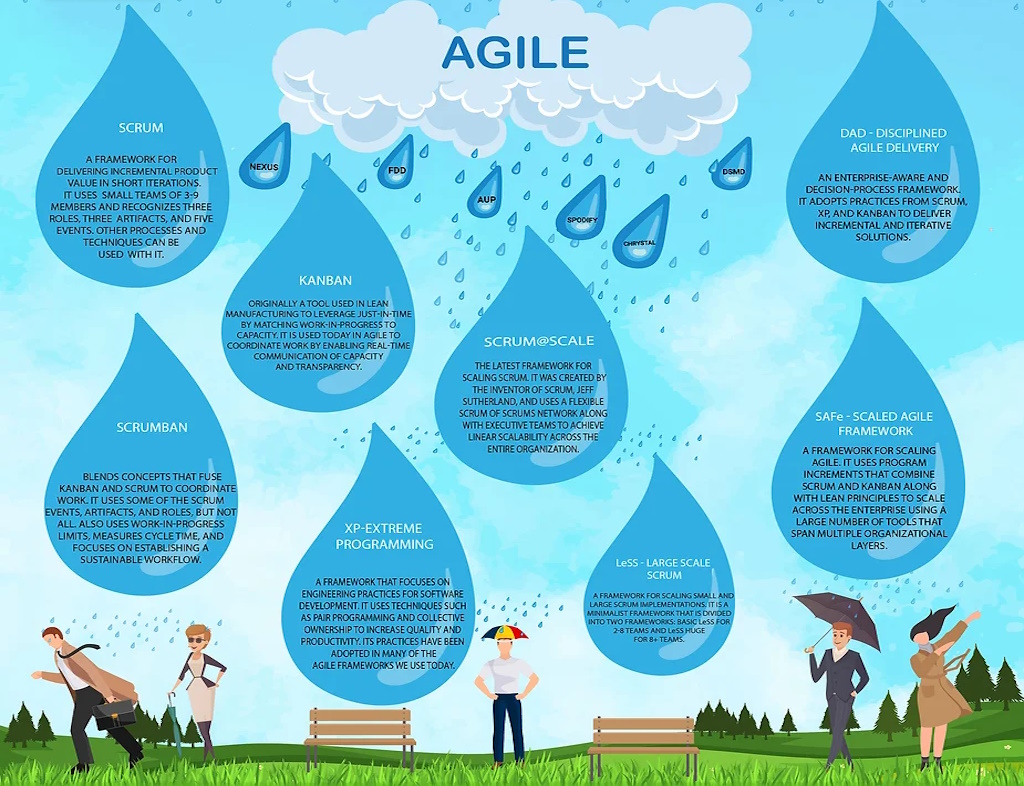
In 2025, Agile methodology continues to thrive by becoming more adaptive and deeply integrated with business strategy and AI technologies. The focus has shifted from simply "doing Agile" to being truly agile, emphasizing customer value, technical excellence, and organization-wide adaptability. I am going to list the key methodologies defining the Agile landscape in 2025:
- Scrum has over 87% of popularity and adoption, with defined roles (PO, Scrum Master) and iterative delivery.
- Over 56% of popularity goes to Kanban, because of visual workflow, continuous delivery, and Work-In Progress (WIP) limits.
- Scaled Agile Framework (SAFe) becomes adopted more than ever with 40% popularity, because of prescriptive framework for scaling Agile across large enterprises.
- Scrumban, a hybrid approach blending Scrum structure with Kanban flow has 27% popularity.
- Various Hybrid Models also grow, blending Agile with structured (e.g., Waterfall) methods.

Emerging Agile Trends and Future Directions
The evolution of Agile is shaped by technological advances and new workplace realities.
- The Return to Fundamentals and Lean Principles: There's a growing movement away from rigid, ceremonial Agile toward its core principles: simplicity, customer value, and continuous improvement. Teams are integrating practices like continuous integration and trunk-based development and showing increased interest in "no estimates" and forecasting approaches to reduce overhead and focus on flow efficiency.
- AI-Powered Agile: Artificial Intelligence is transforming Agile workflows. AI tools automate repetitive tasks, provide predictive insights for sprint planning, generate test cases, and help identify potential risks and bottlenecks. This allows teams to focus more on collaborative and creative work.
- Agile Beyond IT: Agile is now a mainstream business strategy. Its principles are being successfully adopted by marketing (86% of marketers plan to use it), HR, and business operations to improve collaboration and deliver results faster.
- Evolving Agile Roles: Pure, process-focused roles like "Scrum Master" are evolving into hybrid positions that combine technical expertise with process leadership. Similarly, Product Managers are becoming "super ICs" who blend product thinking with strong business analysis skills.
- Remote and Hybrid Team Adaptation: Agile practices have fundamentally adapted to support distributed teams. This includes a greater focus on asynchronous communication, evolved collaboration patterns, and leveraging digital tools to maintain team cohesion and transparency.
Key Challenges and Solutions
Despite its maturity, organizations still face significant hurdles in scaling and sustaining Agile. Though a lot of progress have been made, some of them are listed below:
- Resistance to Change & Culture Clash: Leadership must actively lead the cultural shift, not just mandate it.
- "Siloed" Expertise & "Scattered" Teams: Foster knowledge-sharing groups and rebuild a sense of shared team purpose.
- Misunderstanding Agile as a "Silver Bullet": Focus on mindset and culture, not just ceremonies and processes.
- Lack of Leadership Buy-in: Secure active C-level sponsorship and involvement in the transformation.
- Tool Overload: Streamline tool usage to enhance, not hinder, collaboration and workflow.

Practical Guidance in 2025 Agile Journey
There are some important recommendations for the 2025 Agile Journey to be successful.
To successfully navigate the current Agile landscape, one should embrace a Hybrid or Tailored Approach and it should not force a single framework. Most organizations succeed by creating their own hybrid or custom Agile model that fits their unique context.
Next, it should integrate AI thoughtfully and start experimenting with AI tools for planning, testing, and analytics, but remember they are co-piloting that augment, not replace, human collaboration and critical thinking. One should focus on Agile Leadership, to cultivate leaders who act as servants, coaches, and enablers, emphasizing emotional intelligence and fostering innovation.
Lastly, one should go back to the origins of the Agile principles and prioritize Technical Excellence. In 2025, one should combat technical debt and ensure long-term agility by dedicating time to refactoring and embracing practices like Extreme Programming (XP).

Canadian Companies That Have Being Truly Agile
Leaving in Canada, it is hard for me to see a major breakthrough, but apparently several Canadian organizations and their leaders are being recognized in 2025 for exemplifying true agility by driving innovation, delivering customer value, and achieving strategic adaptability. Here are specific examples of Canadian organizations and leaders recognized for these qualities in 2025:
- Ontario Power Generation for groundbreaking IT initiatives delivering measurable value and redefining industry excellence
- Kruger Inc for implementing groundbreaking IT initiatives that deliver measurable value
- BC Investment Corporation for transformational change and successful delivery on organizational goals through IT innovation.
What these recognitions tell us is that the awards and recognitions highlighted above are not just for isolated projects, but they signal a deeper, organization-wide commitment to modern agile principles. The common threads connecting these winners are:
- Strategic Alignment and Measurable Impact: The awards specifically honor the seamless alignment of IT services with business goals to deliver strategic value and measurable results. This moves beyond simply "doing agile" to ensuring that agility directly contributes to the bottom line and core mission.
- A Focus on Value-Driven Innovation: The "Innovator of the Year" category celebrates organizations that implement groundbreaking initiatives that deliver measurable value and redefine excellence within their industries. This reflects a focus on customer and business value over rigid processes.
- Leadership and Inclusivity as Catalysts: The recognition of leaders like Navpreet Uppal highlights that fostering inclusive workplaces and mentoring future talent is a critical component of building a resilient and adaptable organization.
The broader landscape shows how Canadian entities are applying agility to meet new challenges by adapting to social expectations. Canadian companies are navigating a complex environment by staying committed to long-term social purpose and adapting their collaboration models. They are cautiously tailoring communications while holding firm on core commitments, demonstrating strategic adaptability.
Municipalities like Edmonton, Gatineau, and the Region of Peel are participating in community-level agility initiatives, like the Adaptive and Resilient Communities Cohort (ARCC). This program focuses on action-oriented learning to overcome barriers to climate adaptation, showcasing adaptability in public service and planning.
In the consumer goods sector, agility means responding to demand for Canadian products by embracing evidence and transparency. Leading companies are succeeding by defining "Canadian" clearly and proving origin with evidence, aligning their operations with clear, verifiable customer value. The organizations and trends provide a concrete look at how "being truly agile" is being practiced in Canada today.

Province Ontario Companies That Have Being Truly Agile, Emphasizing Technical Excellence and Organization-wide Adaptability
I was almost about to finish the article, when it clicked: why not researching what are Agile trends in Ontario?
The Ontario Public Service (OPS) has a formal and active commitment to adopting Agile methodologies, applying them not just to digital projects but also to policy and program design. This is supported by leadership and visible through training, specific project successes, and government-backed innovation events. Well, the Ontario government provides a detailed online guide for its employees on "Being agile in the Ontario Public Service". This resource is crucial for understanding the official approach. There are several important components of this approach.
Teams building government digital services are required, actually mandated, to use Agile methods to meet the Digital Service Standard
The OPS emphasizes five core Agile principles: focusing on user needs, delivering iteratively, keeping improving how your team works, failing fast and learning quickly, and continuous planning
The guide also provides methodology guidance, by explicitly recommending and explaining specific methods, like Scrum and Lean-Kanban, noting that Scrum is a good starting point for organizations new to Agile.

OPS Agile in Action: Projects and Roles
Agile is not just a theory in the OPS, but it's being applied to deliver real projects and create new roles. In OPS government projects, Scrum Masters act as servant leaders and coaches. They facilitate cross-departmental collaboration (bringing together developers, policy experts, and legal advisors) and help leadership adapt to an Agile mindset. Their work is linked to tangible benefits, including delivery speeds 50-70% faster than traditional models in some pilot projects.
While not always explicitly labeled "OPS," projects within Ontario's public sector illustrate Agile success:
- Digital Health Ontario used Agile frameworks to deploy virtual care platforms and integrate digital health records, enabling over 80% of primary care providers to access electronic patient data
- City of Toronto Open Data Portal relied on Scrum Masters to foster collaboration across different departments, resulting in the public release of over 300 datasets
- E-Services Modernization, a provincial agency in Ontario launched citizen-facing portal upgrades every 8 weeks through Scrum, a process that previously took years.
The Agile transformation in Ontario's public sector is part of a larger push for innovation, supported from the highest levels. With leadership-driven innovation, the Government Innovation Showcase Ontario is a premier event supported by the Government of Ontario, convening top leaders like the Secretary of the Cabinet and various Chief Information Officers. The event's tracks—such as Digital Services & Customer Experience and Data, Analytics & AI—focus on core Agile themes like user-centric design, iterative improvement, and cross-agency collaboration.
with Focus on Digital Transformation, the government's strategic investments in digital and IT modernization, as outlined in its budget, create an environment where Agile methods are essential for success
The tools and techniques used by Scrum Masters in government projects like those in the OPS are specifically chosen to navigate the unique challenges of a public sector environment, such as compliance, transparency, and cross-departmental collaboration.

References:
- Looking Ahead—Common Challenges to Scaling Agility in 2025 - by Punita Dave on Scrum Alliance site
- Agile in 2025: Expert Predictions and Industry Trends - published on January 7, 2025 in Easy Agile
- The Future of Agile – 3 Key Trends to Watch Out For - published by Tech Systems
- The Future of Agile: Trends to Watch in 2025 and Beyond - published on January 29, 2025 by Mario H. Trentim on LinkedIn website
- Agile Adoption Challenges: Why Teams Struggle & How to Fix Them - published on August 11, 2025 by Krutika Khakhkhbar on Peerbits website
- Agile Trends: The 2025 Guide - published by Agilemania
- Amid The AI Hype, Agile Still Remains Relevant In 2025 - published on January 23, 2025 by Diego Lo Guidice on Forrester website.