
Why is Scrum the Most Popular Agile framework ?
As it is fashionable nowadays, I have decided to consult Artificial Intelligence (AI) to find the answer to this question. So ChatGPT had dutifully summarized various query responses in its "message" response as the following:
Scrum is a popular Agile framework because it's simple, flexible, and focuses on teamwork. It's also effective for managing products and services. The most important Scrum benefits are:
- Efficiency: Scrum helps teams complete projects quickly and efficiently.
- Time and money management: Scrum ensures that time and money are used effectively.
- Sprint-based: Scrum divides large projects into sprints that are easier to manage.
- Continuous improvement: Scrum provides a framework for focusing on iteration and continuous improvement.
- Collaboration: Scrum values like openness, courage, and respect encourage collaboration.
- Adaptability: Scrum is a process that can be adapted to the current context and circumstances.
- Scrum helps teams structure and manage their work through: values, principles, and practices.
- Scrum teams commit to delivering work at the end of each sprint. They adopt practices and a team structure to help them achieve this cadence.
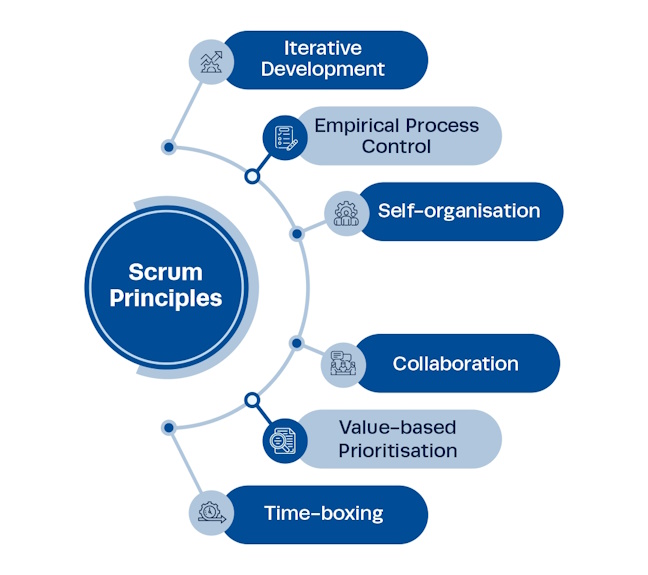
All mostly true, because the foundation on which Scrum framework is based is applicable to any type of project or business, and it can be modified to meet the requirements of the project or an organization, but the core framework principles in theory are not negotiable. These six principles of Scrum Framework have been visualized on the picture below.
How Come People Adopted the Scrum Agile framework ?
Adopting and practicing Agile Methodology since 2005, I do can attest that Scrum came as the best-fit Agile framework that I have embraced to help teams collaborate and deliver a final product. At the time I was leading extremely stretched consulting development teams that were mostly buried under tons of documentation usually required by the Waterfall model. That was the time just 4 years after the Agile Manifesto was created in February 2001, which not all of us had clearly understood. Forced by necessity, the development teams decided to take a leap of fate, and engage in Agile Development utilizing Scrum as prevalant framework to deliver quicker release of usable product to users and customers. Though there was healthy Agile frameworks competition (Extreme Programming, Kanban, etc.), in hindsight and though fundamentally wrong, what made the Scrum framework easily adoptable was that was simple and a view that Sprints are comparable to a Waterfall phase, but are actually short work periods. Inasmuch as the waterfall model is characterized by its sequential nature and emphasis on upfront planning, a web of transient connections was made, and I worked relentlessly to convert existing project schedules into Backlogs and Sprints. Shortly thereafter scoring some major successes, the management had succumbed to the reality that though the Scrum is incomplete as it just provides people with guidance rather than strict and detailed instructions, it is still one of the best frameworks for delivering value.
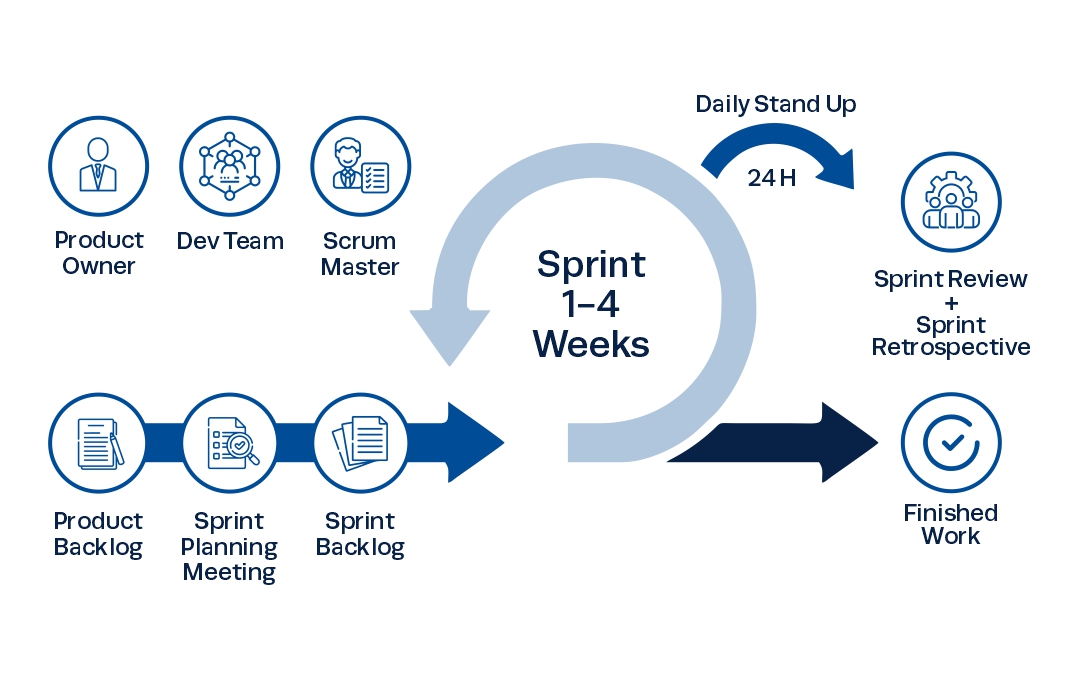
Though Scrum origins precedes Agile Manifesto, Jeff Sutherland, Ken Schwaber, and Mike Beedle later applied Scrum ideas to the field of software development and created a new method - Scrum. This method was first introduced in the early nineties, with the workflows depicted in the illustration below.
Why is Scrum The Most Popular Agile Framework ?
Both Agile and Scrum framework, rely on an iterative process, frequent client interaction, and collaborative decision making. The key difference between them is that Agile is a project management philosophy that utilizes a core set of values or principles, while Scrum is a specific Agile framework that is used to facilitate an initiative. The rise of Agile transformation to support the transition from traditional project management to an Agile, product-oriented mindset, helping the team embrace Agile principles, particularly in the development and delivery of high-quality products and services, in reality means expanding role of the Scrum Framework. Enterprises striving for improving team collaboration, efficiency, and responsiveness to change, helping transition the team from a project-based mindset to a product-oriented, iterative development approach, that all leads to the higher implementation of the Scrum Framework.
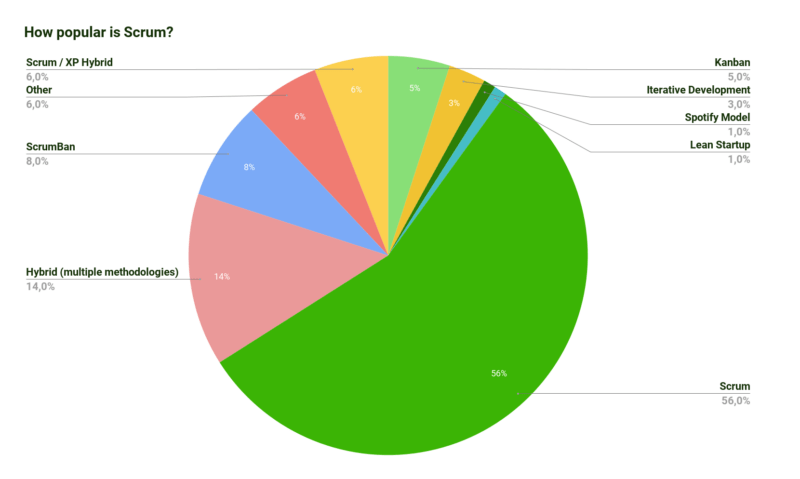
There is little doubt that Scrum is the most popular Agile frameworks in 20224. According to various sources, the percentage of projects using Scrum in 2024 is between 66% and 87%, as depicted on the pie graph below.
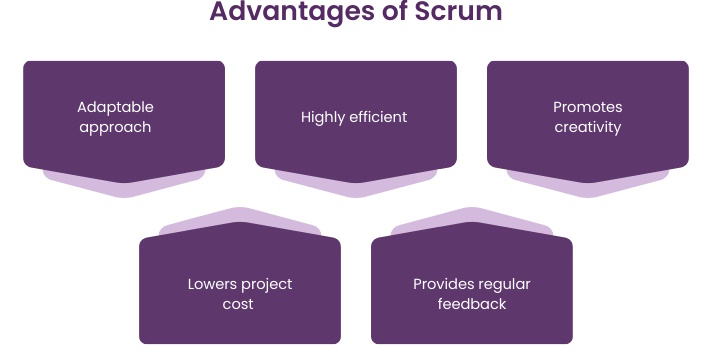
So it is a time now to answer the question and reveal the major Scrum Framework advantages, that makes it quintessential part of enterprise development and delivery. Scrum provides:
- Flexibility and adaptively
- Quick and efficient deliverables
- Effective use of time and money
- Ensures continuous feedback
- Great for fast-moving development projects
- Large projects are divided into easily manageable sprints
- The team gets clear visibility through time-boxed (daily) meetings
- The individual effort of each team member is visible and appreciated.
The image below outlines some of Scrum Framework advantages.
Needless to say to say that Scrum also has some major disadvantages, illustrated on the picture and listed below.
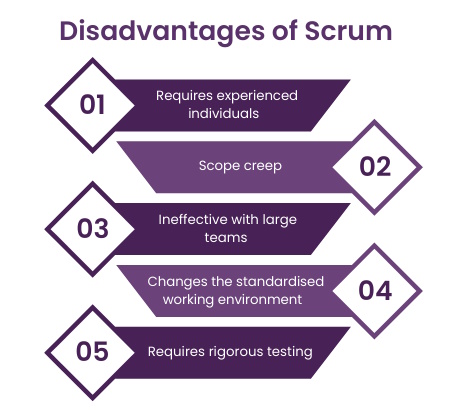
- Does not have a strictly set deadline
- Due to that, it can often lead to scope creep
- Requires a team environment with a lot of knowledge and experience
- If any member leaves while the project is still unfinished, it can have a huge negative impact on the result
- Lack of willingness to collaborate can lead to project failure
- Daily meetings can be frustrating to some team members
- Not appropriate for large and complex projects
- Requires transformation at organizational level.
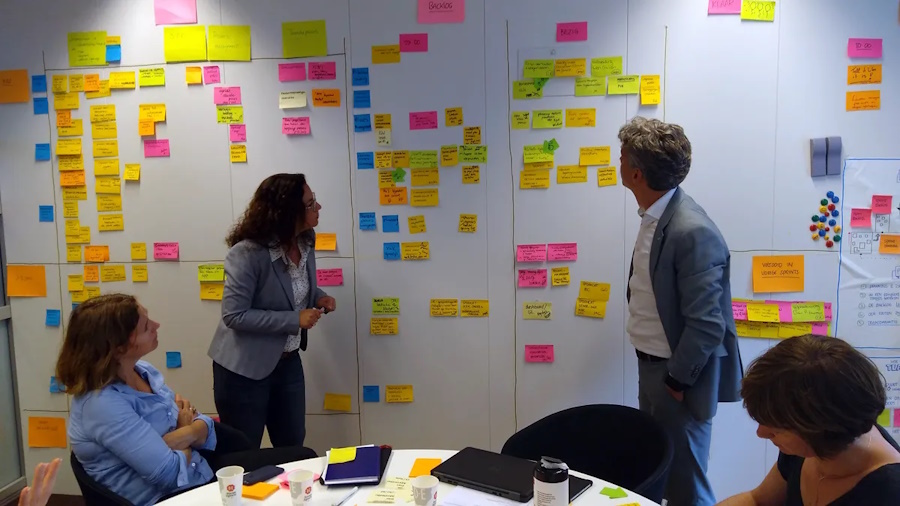
Just a light glance over the above picture may give some insight why sometimes developers say that Scrum sucks. Though being a great Agile framework, one of the major drawback is that unlike waterfall development, Agile/Scrum projects have a fixed schedule and resources while the scope varies, which very often leads to promoting Minimum Viable Product (MVP) as the final outcome, as described here. Because resources (budget) and time (schedule) are fixed, it's easier for development teams to change the project scope to meet the requested goals and objectives. Suddenly, the Agile project scope becomes stretchable elastic band, it can be anything that comprises minimum set of values. In this situation, the consensus among the team, which might be forced upon the sponsor(s) is to build something that would deliver small set of features (scope) that provides customer with some value.
Next, the Scrum team is rarely self-organized team, particularly in government and other regulated agencies organizations. Though developers know what application development frameworks and programming languages work best for them, very often these tools got selected by PMO or Architecture groups, so the principle that "The best architectures, requirements, and designs emerge from self-organizing teams" simply doesn't apply. As often happens, due to complacency and fear of being left behind, the team ends up using Azure Power BI reporting module as front-end GUI tool, as example, though in essence it is a business analytics tool that helps users visualize data and share insights.
Along with above, very often the team members have no time for cross pollinating or exchange with peers, because when team velocity is the only measurement, the team no longer has time to consult, to exchange opinions, to run a concept by someone, to prototype. A large part of what makes Scrum great gets "lost in translation".
When features got priority over robust code, and the architecture becomes ticket-driven, the Agile principle "Continuous attention to technical excellence and good design enhances agility" comes as dead letter. Unless the product owner is technical, Scrum massively devalues that as the product owner isn't evaluating the code. Scrum itself unintentionally becomes messy architecture, while the team is working through tickets sequentially and independently from each other as “the architecture rapidly begins to mirror the tickets.”
To maintain the required level of team velocity, very often complicated tasks get deprioritized in the backlog, creating the illusion of productivity—there is a focus on getting any ticket to ‘done,’ while deep thinking does not look very productive. Doing this, a developer looks super productive on paper and in Daily Scrums, though in a reality the product development suffers. Unexpectedly, Scrum encourages picking work that can easily be done and rapidly churned out at a steady pace.
Very often, there is huge disagreement between developers, testers and use acceptance team on the 'Definition of Done' or DoD, and how this helps with keeping standards and expectations for the individual clear. The most pressing questions are who creates it and when, so it may require the Scrum Master to enforce quality constraints if the team doesn't have clear development standards.
Some development teams argue that not following the Scrum rules properly enough is the root cause of all the problems. Some argued against the Scrum process as it is about it becoming the process that overrides everything else, and by this might break a winning team: “Scrum bends and breaks every other process to it and becomes this overarching process where you do nothing consistently except Scrum rituals and making those Scrum rituals seem successful.” As described here, in spite of being the most popular Agile framework, more than two decades after Agile Manifesto, Scrum Framework also remains elusive.